
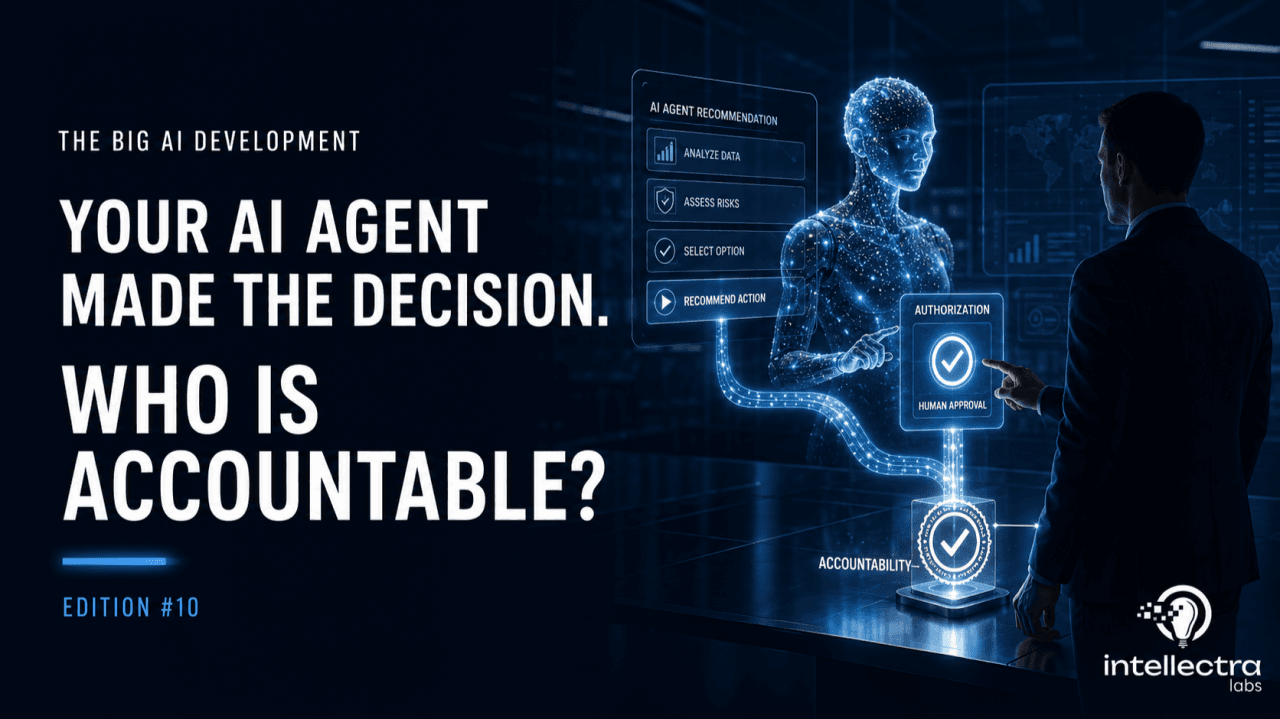
Enterprise AI is crossing a threshold. Agents no longer merely recommend—they act. They adjust inventory, approve exceptions, trigger payments, escalate alerts and execute workflows that once required human initiation. The efficiency gains are real. So is the governance gap.
When an agent makes or executes a decision, a question follows immediately: who is accountable? If the answer is unclear, the organisation has not deployed intelligence. It has distributed liability.
When agents act, accountability cannot disappear into the model. Someone must own the outcome.
The Accountability Vacuum
In traditional operations, every decision has a traceable owner—a manager who approved, a analyst who recommended, an executive who signed off. Agentic systems disrupt this clarity. The agent acted. The model inferred. The system automated. But when something goes wrong, fingers point in every direction except a named human owner.
- IT says the business defined the requirements.
- The business says IT deployed the agent.
- The vendor says the model performed as designed.
- Leadership discovers accountability was never assigned.
This vacuum is not a technical failure. It is a governance design failure—and it becomes dangerous the moment agents operate at scale.
Accountability Before Automation
Governance for agentic AI must be designed before automation scales, not after an incident forces the conversation. Every agent requires explicit answers to four questions:
- Who owns this agent's outcomes — the human leader accountable when it acts.
- What may it decide autonomously — and what always requires human approval.
- What boundaries apply — financial limits, risk thresholds and policy constraints.
- How are exceptions handled — escalation paths when the agent encounters uncertainty or breach.
These are not compliance checkboxes. They are the operating contract between the organisation and the agent workforce.
Ownership, Not Vendor Shield
Some organisations hope that vendor terms, model cards or audit logs will substitute for internal accountability. They will not. Regulators, customers and boards hold the enterprise responsible—not the model provider.
Accountability means a named leader who reviews agent performance, adjusts boundaries as conditions change, intervenes when outcomes deteriorate and accepts responsibility for decisions the agent executes within its mandate.
Governance as Operating Design
Effective AI governance is not a policy document stored on a shared drive. It is embedded in how agents are designed, deployed and monitored:
- Decision logs that record what the agent did, why and under whose authority.
- Audit trails that connect agent actions to business outcomes over time.
- Review cadences where owners assess performance and adjust boundaries.
- Kill switches and escalation triggers for when agents must stop and defer to humans.
- Clear separation between agents that recommend and agents that execute.
Design, deploy and govern AI agents as accountable participants in enterprise decision-making.
Strategic Reflection
Pick any agent currently acting in your organisation. Can you name the human owner accountable for its outcomes—not the team that built it, but the leader who owns what it decides?
If the answer is no, you have automation without governance. The next incident will not be a model failure. It will be an accountability failure you should have designed away.
Originally published as an edition of The Big AI Development on LinkedIn. This page forms part of the permanent Intellectra Insights archive.