
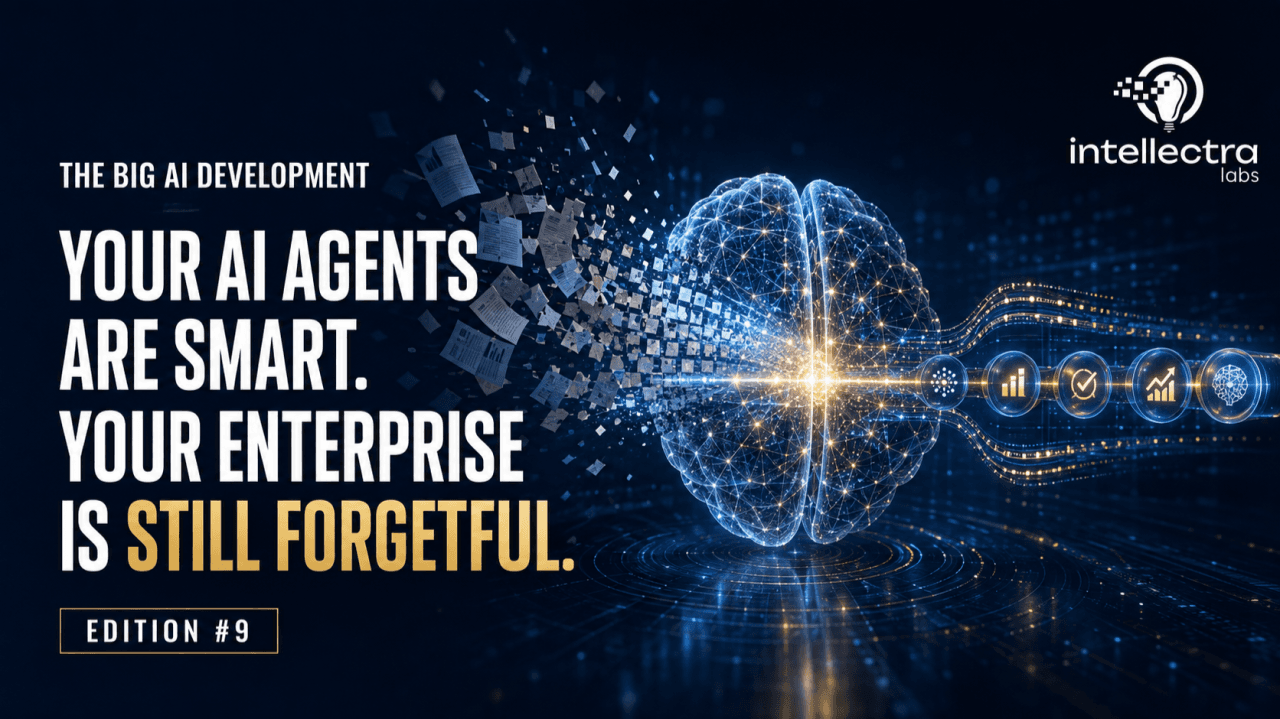
Enterprise AI agents are becoming remarkably capable. They retrieve information, synthesise analysis, recommend actions and execute workflows. Yet many organisations discover a frustrating pattern: the same mistakes recur, the same context is re-learned from scratch and the same questions are answered as if they were never asked before.
The agents are smart. The enterprise is forgetful. And until the organisation learns to remember, AI will optimise moments—not systems.
AI will not transform the enterprise until the enterprise learns to remember its decisions, outcomes and context.
The Amnesia Problem
Most enterprises store data abundantly but remember decisions poorly. A forecast was overridden—but why? A promotion underperformed—but what assumptions drove the investment? A supplier was switched—but what evidence informed the change?
When this institutional memory is absent, agents inherit the same blindness as the humans who came before them. They may access current data but lack the narrative of past choices, outcomes and exceptions that experienced leaders carry in their heads.
- Agents repeat recommendations that were previously rejected for good reasons.
- New team members and new agents start from zero context every time.
- Post-mortems produce reports that nobody retrieves when similar decisions arise.
- Overrides and exceptions disappear into email threads instead of organisational memory.
What Decision Memory Means
Enterprise decision memory is not a data warehouse. It is a structured record of how the organisation decides: what choices were made, what evidence was considered, what boundaries applied, what outcomes followed and what exceptions were granted.
Decision memory connects the past to the present in ways that raw data cannot. It answers not just “What happened?” but “Why did we choose this—and what did we learn?”
- Decision logs — who decided, when, with what evidence and within which boundaries.
- Outcome tracking — what resulted from each decision over time.
- Exception records — when boundaries were overridden and why.
- Context preservation — the market conditions, assumptions and constraints at decision time.
- Pattern libraries — recurring situations and the choices that worked or failed.
Memory as a Strategic Asset
Organisations with strong decision memory compound learning. Each choice improved teaches the next. Each outcome recorded reduces repeated mistakes. Each exception documented prevents governance drift.
Agents connected to decision memory become more than reactive tools. They become participants in a learning system—able to reference prior choices, surface relevant precedents and flag when current conditions resemble past failures.
Building Institutional Recall
Building enterprise decision memory requires deliberate design, not passive data accumulation:
- Capture decisions at the point of choice—not retrospectively in post-mortems alone.
- Link decisions to outcomes with enough lag to measure what actually happened.
- Make memory retrievable in the workflows where future decisions are made.
- Govern what is remembered—some decisions require confidentiality and controlled access.
- Connect memory to agent context so intelligence builds on experience, not just data.
Connect priorities, performance signals, scenarios and executive decisions across the enterprise.
Strategic Reflection
When a critical decision faces your organisation today, can an agent—or a new leader—access why similar decisions were made in the past and what resulted?
If the answer is no, your agents may be intelligent—but your enterprise is still amnesiac. The next phase of AI value belongs to organisations that remember.
Originally published as an edition of The Big AI Development on LinkedIn. This page forms part of the permanent Intellectra Insights archive.