
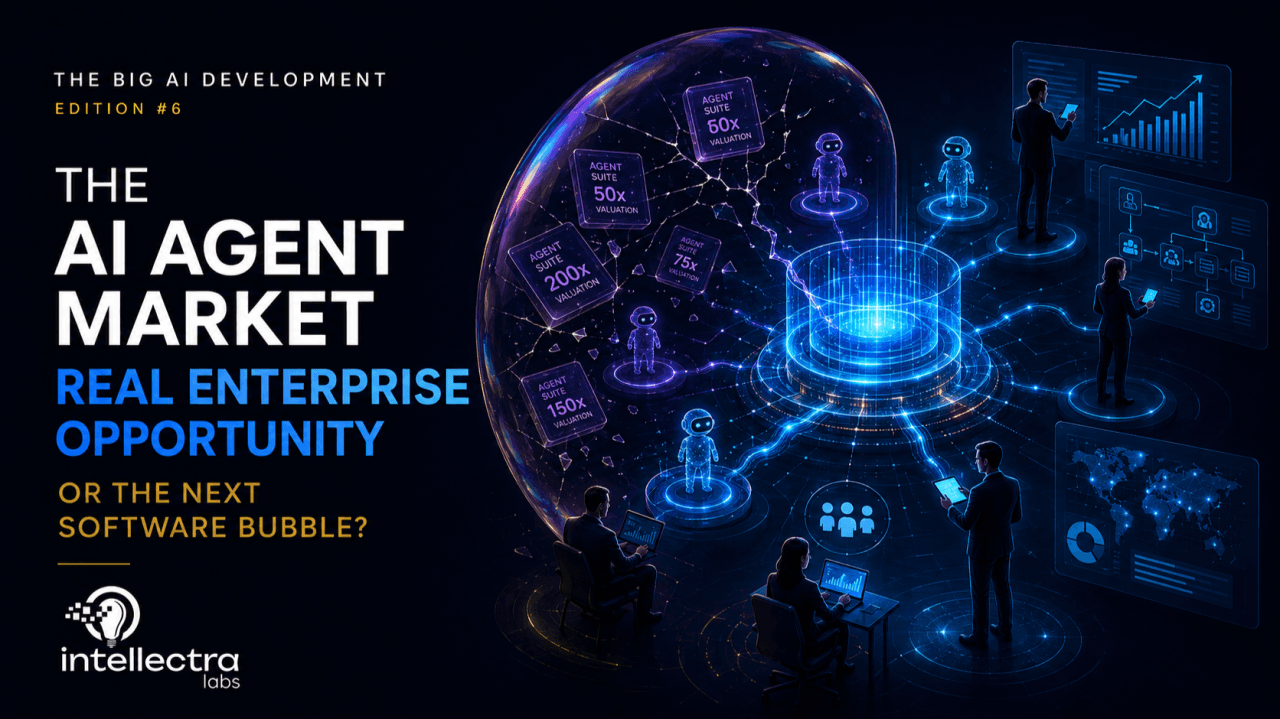
The AI agent market is expanding faster than enterprise clarity. New platforms launch weekly. Funding rounds celebrate orchestration, autonomy and multi-agent workflows. Board decks demand an agent strategy. Procurement teams struggle to distinguish durable operating capability from vendor enthusiasm wrapped in demo polish.
The question is not whether agents matter. They do. The question is whether the current market structure will deliver lasting enterprise value—or repeat the dynamics of prior software bubbles, where narrative outran operating reality.
Agent platforms are multiplying. Leaders must distinguish durable operating capability from market narrative.
Signs of Real Opportunity
Beneath the hype, several structural shifts justify serious enterprise investment:
- Models can now plan, use tools and execute multi-step tasks reliably enough for bounded domains.
- Integration layers are maturing—agents can act across systems rather than merely chat about them.
- Cost curves are improving, making sustained operation economically plausible for high-value decisions.
- Organisations are redesigning decisions, not just automating tasks—creating demand for governed agentic capability.
- Competitive pressure is real: early movers in domain-led deployments are seeing measurable decision improvements.
This is genuine opportunity—but opportunity is not the same as every vendor claim being true.
Signs of Bubble Dynamics
Bubble dynamics appear when valuation and narrative detach from verifiable enterprise outcomes. Warning signs include:
- Platforms sold as strategy substitutes rather than operating components.
- Success metrics dominated by demos, pilots and hours saved rather than decision outcomes.
- Bundling that obscures true cost of inference, integration and oversight.
- Feature parity races that prioritise novelty over governance and interoperability.
- Claims of autonomy without clear accountability, boundaries or auditability.
- Market consolidation narratives used to justify premature standardisation on immature stacks.
Enterprises that confuse market momentum with operating maturity risk locking into platforms that impress in quarter one and constrain in quarter five.
What Enterprises Should Buy
The durable purchase is not an agent catalogue. It is capability to design, deploy and govern agents against business decisions—with portability, observability and clear economics.
Leaders should evaluate vendors and platforms against questions that survive marketing:
- Can we define which decisions an agent supports and who owns outcomes?
- Can we enforce boundaries and escalate before irreversible action?
- Can we observe what the agent saw, inferred and did?
- Can we measure value against the problem, not just activity?
- Can we change models or tools without rebuilding the operating model?
- Can we retire an agent without breaking dependent workflows?
Build, Buy and Bubble Avoidance
Most enterprises will combine build and buy. They will buy infrastructure—models, orchestration, observability—and build domain intelligence, decision maps and governance that no vendor can fully provide.
Bubble avoidance means resisting all-in bets on platforms that promise to replace operating discipline. The winners will treat agents as a new layer in the enterprise stack—designed, measured and accountable—not as magic that makes organisational design optional.
Independent guidance to separate agentic opportunity from hype and design a durable enterprise path.
A Strategic Posture
The prudent posture is neither cynicism nor euphoria. Invest where decisions are high-value, context is available and governance can be defined. Experiment broadly but standardise selectively. Measure outcomes ruthlessly. And remember that market bubbles burst—but operating capability, once built, compounds.
Strategic Reflection
If your agent platform vendor disappeared tomorrow, would you lose demos—or would you lose operating capability tied to critical decisions?
The answer reveals whether you are buying enterprise value—or renting market narrative.
Originally published as an edition of The Big AI Development on LinkedIn. This page forms part of the permanent Intellectra Insights archive.