
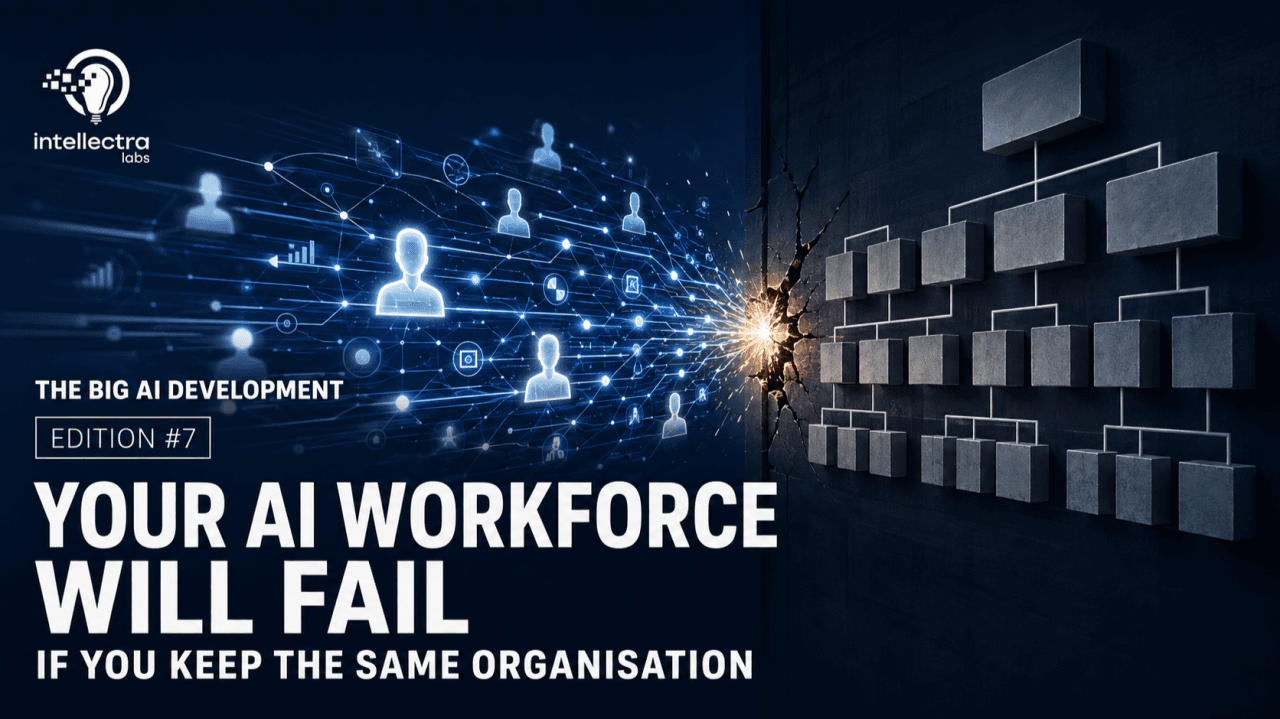
Most enterprises treat AI agents as a technology insertion problem: deploy capability into existing structures and wait for productivity to appear. The agents arrive. The org chart does not change. Within months, friction accumulates—shadow workflows emerge, accountability blurs and leaders wonder why the AI workforce feels more disruptive than transformative.
An AI workforce is not a plugin. It is a new category of labour operating alongside people, processes and systems. If roles, decision rights, incentives and escalation paths remain unchanged, agents will be forced into gaps the organisation was never designed to accommodate.
Adding agents to an unchanged organisation does not create an AI workforce. It creates organisational collision.
The Structure Problem
Traditional organisations were designed for human bandwidth: limited attention, sequential handoffs, meeting cadences and approval hierarchies. Agents operate differently. They can monitor continuously, act within milliseconds and scale across workflows without fatigue.
When agents are inserted into human-designed structures, several predictable failures follow:
- Nobody owns the agent's outcomes because no role was redesigned to include it.
- Human approvers become bottlenecks for decisions agents could handle within boundaries.
- Teams create parallel workflows outside official systems to avoid governance friction.
- Incentives still reward individual heroics rather than decision quality improved by agents.
- IT owns deployment while the business owns outcomes—and the two never fully align.
Redesign Roles, Not Just Tools
Organisational redesign for an AI workforce begins with roles. Every agent should have a defined place in the operating model—what it monitors, what it recommends, what it may execute autonomously and which human leader remains accountable.
This is not about replacing people. It is about reallocating human attention to judgment, exception handling and relationship work while agents handle evidence gathering, routine execution and continuous monitoring within defined boundaries.
- Decision rights — who may approve, override or halt agent actions.
- Role clarity — which human owns each agent's performance and boundaries.
- Workflow integration — where agents sit in official processes, not shadow paths.
- Incentive alignment — rewards tied to outcomes agents and humans produce together.
- Escalation design — clear triggers for when human judgment must intervene.
From Pilot to Workforce
Pilots succeed in isolation because they bypass organisational complexity. A demand-planning agent in a sandbox does not compete with existing approval chains, conflicting KPIs or territorial data ownership. Scaling requires confronting that complexity directly.
Leaders who treat organisational redesign as a post-pilot activity discover that scaling is not a technology problem—it is a change management failure they labelled as an AI failure.
A step-by-step guide to creating AI agents and an agentic roadmap for FMCG and CPG organisations.
Design Principles for the AI-Augmented Organisation
Successful organisational redesign for agentic capability follows a consistent logic:
- Start with decisions, then assign agents and humans to roles around those decisions.
- Make agent ownership explicit in management structures—not buried in IT project lists.
- Redesign workflows before scaling agent count.
- Align incentives to decision quality and business outcomes, not activity metrics.
- Build governance into the operating model, not as a compliance afterthought.
Advisory support for organisational redesign, operating model change and agentic transformation.
Strategic Reflection
For every AI agent currently operating in your organisation, can you point to the role, decision rights and human owner that were explicitly redesigned to accommodate it?
If the answer is no, you may have deployed technology—but not yet built an AI workforce. The organisation is still shaped for a world without agents, and the agents are paying the price.
Originally published as an edition of The Big AI Development on LinkedIn. This page forms part of the permanent Intellectra Insights archive.