
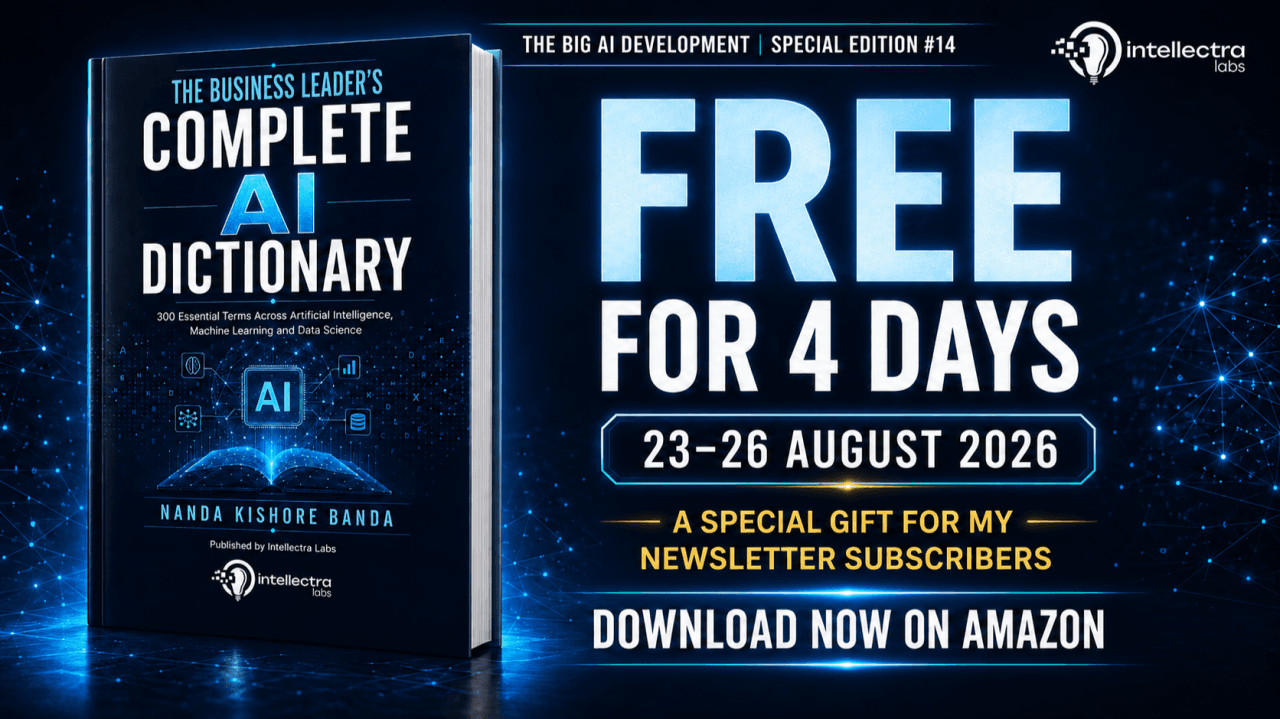
This special edition focuses on a problem every executive now faces: artificial intelligence has its own language—and leaders who cannot speak it cannot lead it.
Boardrooms are full of confident references to models, agents, embeddings, fine-tuning, guardrails and inference. Yet many leaders still leave those conversations without the vocabulary to challenge assumptions, evaluate vendors or design governance. That gap is no longer a technical inconvenience. It is a strategic liability.
AI fluency is not programming. It is the ability to name what you are buying, what you are permitting and what you are accountable for.
You cannot govern what you cannot name. AI vocabulary is becoming a leadership capability—not an engineering speciality.
Why Leaders Need a Dictionary
Technology language shapes investment. When leaders share precise definitions, meetings shorten and decisions sharpen. When vocabulary is vague, the same conversation produces enthusiasm without direction—budget without boundaries—pilots without purpose.
The Business Leader's AI Dictionary was written for this moment: three hundred essential terms across artificial intelligence, machine learning and data science—explained in language a business leader can use with boards, vendors and technology teams.
- Foundation models and fine-tuning — general intelligence adapted to your domain.
- Training, inference and cost — where investment concentrates and usage accumulates.
- Embeddings and retrieval — how models find and use organisational knowledge.
- Agents, tools and orchestration — when AI moves from answering to acting.
- Guardrails, governance and human oversight — how to permit capability without surrendering control.
- Bias, evaluation and monitoring — why deployment requires ongoing discipline.
Each term connects to a business decision: what to build, what to buy, what to permit, what to measure and what to stop.
From Vocabulary to Strategy
Shared language enables shared strategy. When leaders understand what an agent is, they can define what it may do. When they understand inference cost, they can set usage boundaries. When they understand bias, they can demand testing before deployment.
Without that vocabulary, AI strategy becomes a slide deck attached to a capability nobody in leadership truly comprehends.
300 essential AI, machine learning and data science terms—explained for business leaders.
Special Edition Offer
When this edition was originally published, it included a complimentary Kindle download of The Business Leader's AI Dictionary for newsletter subscribers—a four-day promotion running from 23 to 26 August 2026.
That promotion has ended. The book remains available through Intellectra Labs and major retailers. Current availability and pricing may be viewed on the book page.
Strategic Reflection
In your last AI strategy discussion, how many terms were used that you could not define precisely?
That count may indicate how much of your AI investment is currently guided by confidence—and how much by assumption.
Originally published as an edition of The Big AI Development on LinkedIn. This page forms part of the permanent Intellectra Insights archive.