Artificial intelligence has entered boardroom conversation faster than most leaders’ working vocabulary. Teams hear about models, agents, embeddings, fine-tuning and governance in the same meeting—and reasonable executives hesitate to ask what these terms actually mean for decisions they must make.
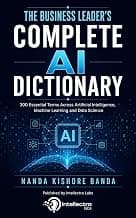
The Business Leader’s AI Dictionary closes that gap without turning the reader into a programmer. It explains eighty essential concepts from artificial intelligence, machine learning and data science in plain English, organised for practical reference rather than academic sequence.
Each entry is written for a business audience: what the idea is, why it matters commercially, how it appears in vendor conversations, and where confusion commonly arises. The goal is confidence, not credentialism. Leaders should be able to challenge proposals, set expectations and participate in design discussions without relying entirely on translation from technical teams.
The book supports a wide range of moments: evaluating an AI roadmap, reviewing a pilot, briefing the board, negotiating with vendors, or simply trying to distinguish durable capability from fashionable language. It helps leaders ask better questions—about data, risk, cost, accountability and value—at the point where projects are still shapeable.
Because AI adoption is as much an operating-model challenge as a technology challenge, the dictionary also connects terminology to decision implications. Understanding a concept is useful only if it changes how leaders prioritise, govern and invest.
This is a reference work designed to stay on a desk, not a manifesto claiming that AI solves every problem. It equips executives, product owners, strategy leaders and transformation teams with a shared language so that AI conversations become clearer, shorter and more honest about trade-offs.