
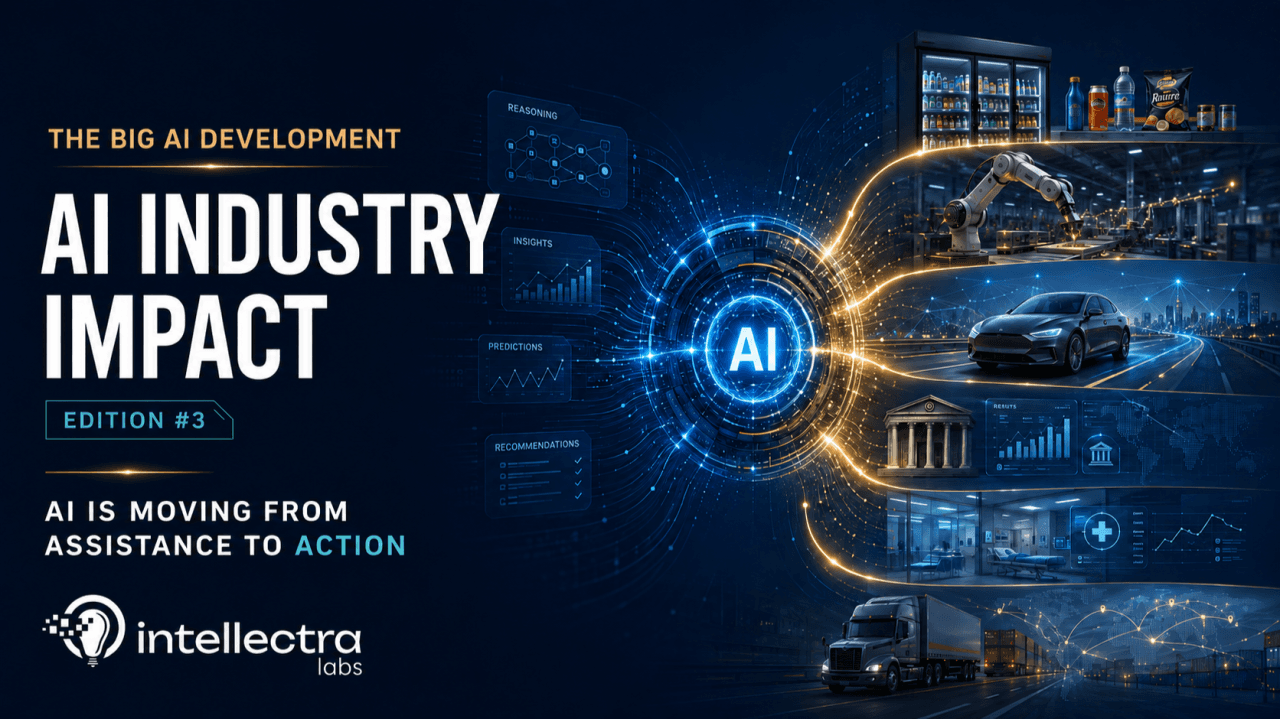
For a decade, enterprise AI largely meant assistance: answer a question, draft a document, classify an image, suggest a next step. The human remained the actor. The model remained advisory. That boundary is dissolving.
Agents now book meetings, update records, trigger workflows, negotiate within parameters and execute multi-step tasks across systems. Artificial intelligence is becoming an enterprise actor—not a passive tool waiting for instructions.
Assistants answer questions. Actors take action. The enterprise must redesign accountability for the second category.
The Assistance-to-Action Shift
The shift is not merely technical. It is organisational. When AI assists, failure modes are contained: a bad summary is corrected, a wrong classification is overridden. When AI acts, failure modes propagate: orders are placed, payments are released, customers are contacted, inventory is moved.
- Assistance supports human judgment.
- Action substitutes for human execution—within or beyond intended boundaries.
- Assistance errors are visible in drafts.
- Action errors become operational facts.
What Changes Inside the Enterprise
Enterprises designed for human actors assume latency, negotiation and informal escalation. Agents compress time. They do not pause for hallway conversations. They do not intuit unwritten policy. They execute against the objective and tools they were given.
This creates three immediate design pressures. First, decision rights must be explicit—who owns outcomes when an agent acts on their behalf. Second, controls must be architectural—not policy documents nobody reads. Third, operating models must define where agents act autonomously, where they recommend and where they are forbidden to intervene.
Accountability Cannot Vanish Into the Model
The most dangerous sentence in enterprise AI is: the agent decided. Decisions always have owners—human owners. When an agent executes, accountability must remain visible: who authorised the capability, who monitors performance, who responds when boundaries are breached and who explains outcomes to regulators, customers or the board.
Action without accountability is not automation. It is abdication with better interfaces.
Learn how to design agents with clear purpose, boundaries and accountable ownership.
Controls for Enterprise Actors
Governance for acting agents requires more than acceptable use policies. It requires control design:
- Objective clarity — what the agent is optimising for, stated in business terms.
- Tool permissions — which systems may be read, written or triggered.
- Financial and risk boundaries — hard limits before human escalation.
- Audit trails — evidence of what the agent saw, inferred and did.
- Kill switches — the ability to halt an agent without redeploying infrastructure.
These controls must be designed before scale—not retrofitted after an agent discovers a path around them.
Design an agentic workforce with accountable roles, decision rights and operating discipline.
Redesigning the Operating Model
Moving from assistance to action is not a feature upgrade. It is an operating model transition. Functions must decide which decisions agents may execute, which they may recommend and which remain human-only. Incentives must align—teams should not be measured on activity while agents are measured on outcomes.
Organisations that treat action-capable AI as a smarter chatbot will discover the difference painfully. Organisations that redesign accountability, controls and roles will treat agents as a new class of enterprise actor—with the same seriousness applied to any role that can move money, inventory or customer trust.
Strategic Reflection
Which of your AI deployments can take action today—and who would explain that action to a customer, auditor or regulator tomorrow?
If the answer is uncertain, you are still in the assistance era in practice, even if your vendor slides have moved on.
Originally published as an edition of The Big AI Development on LinkedIn. This page forms part of the permanent Intellectra Insights archive.