
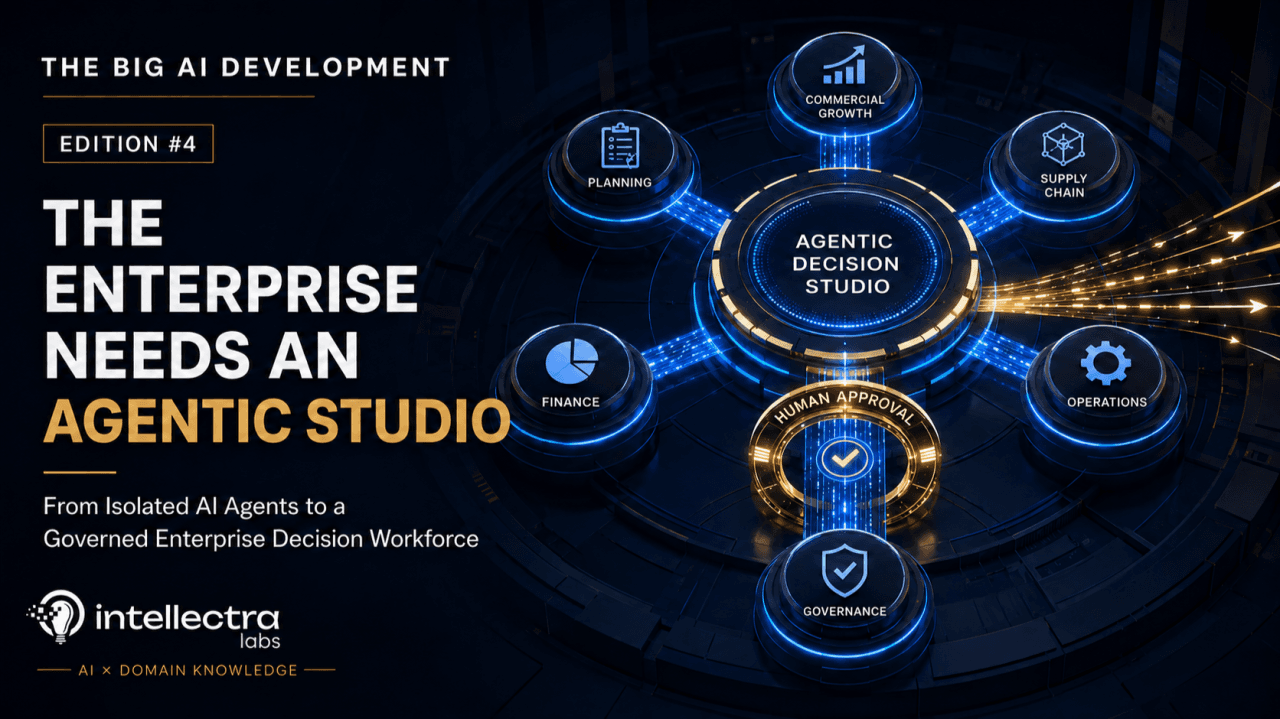
Isolated agents multiply quickly. Sales builds one. Supply chain builds another. Finance experiments in a sandbox. IT deploys a platform. Each demo works. Together, they create fragmentation—overlapping tools, inconsistent governance, duplicated context and nobody accountable for how intelligence coordinates across the enterprise.
The missing layer is not another agent. It is an agentic studio: a coordinated operating environment where agents are designed, deployed, governed, measured and improved as enterprise capability—not as departmental curiosities.
Isolated agents multiply. An agentic studio coordinates intelligence as a new enterprise operating layer.
Why Agent Catalogues Fail
An agent catalogue answers the question: what can we build? An agentic studio answers a harder question: how does coordinated intelligence run the business responsibly at scale?
- Who may create an agent, and under what standards?
- Which decisions may agents touch, and with what boundaries?
- How is context shared so agents do not re-learn the enterprise independently?
- How are outcomes measured, compared and improved over time?
- What happens when two agents influence the same decision differently?
Without a studio layer, each of these questions is answered locally—if at all. The result is intelligent chaos: capable components, incoherent system.
What an Agentic Studio Does
An agentic studio is not a single product category. It is an operating construct—people, process, platform and principles—that treats agents as managed enterprise assets.
It provides design discipline: templates for job descriptions, decision maps, tool permissions and escalation paths. It provides deployment discipline: environments, versioning, testing and release controls. It provides governance discipline: ownership, auditability and boundary enforcement. And it provides learning discipline: capturing outcomes so the next agent benefits from the last.
Coordinated Intelligence
The strategic value of a studio emerges when agents interact with the same decisions, data and constraints—not when they remain siloed assistants.
A promotional planning agent and a demand forecasting agent should not contradict each other silently. A procurement agent and a finance agent should not optimise locally while destroying cash flow globally. Coordination requires shared context, shared boundaries and shared accountability structures—exactly what a studio exists to maintain.
A structured approach to building governed, scalable agentic capability inside the enterprise.
Core Studio Capabilities
- Agent registry — inventory of agents, owners, decisions supported and status.
- Context services — curated knowledge, signals and memory accessible across agents.
- Policy engine — boundaries, approvals and escalation enforced consistently.
- Observability — traces of agent reasoning, tool use and outcomes.
- Lifecycle management — design, test, deploy, monitor, retire.
- Performance analytics — value created, cost incurred, trust earned.
Enterprises need not build all of this on day one. They must, however, decide that coordination is the goal—not accumulation.
Build a coordinated agentic workforce with clear roles and enterprise-wide operating discipline.
From Experiments to Operating Layer
The agentic studio represents a maturation path. Phase one is experimentation—proving that agents can support specific decisions. Phase two is standardisation—shared design patterns, governance and context. Phase three is operating layer—agents become part of how the enterprise runs, reviewed like any critical process.
Leaders who skip phase two will never reach phase three. They will have agents. They will not have an agentic enterprise.
Strategic Reflection
Can you name every agent operating in your enterprise, its owner, the decision it supports and how its performance is measured?
If not, you do not yet need more agents. You need a studio.
Originally published as an edition of The Big AI Development on LinkedIn. This page forms part of the permanent Intellectra Insights archive.