
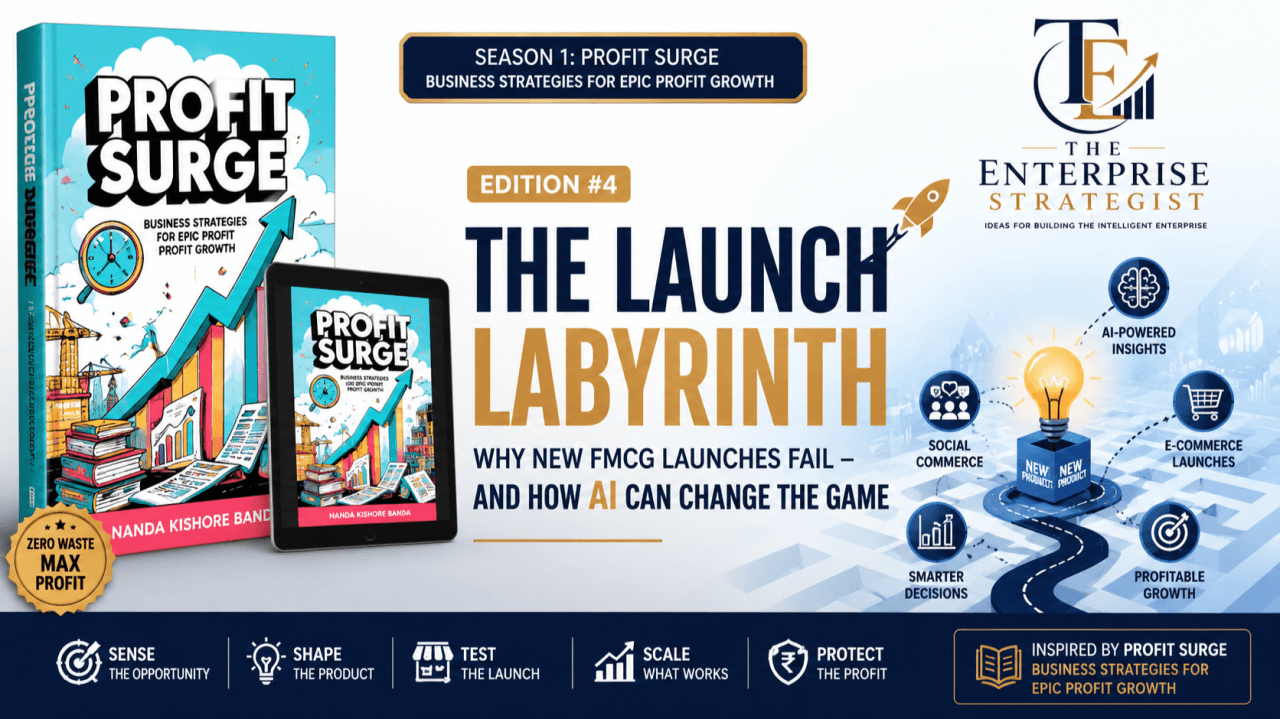
New-product launches fail when consumer evidence, distribution, forecasting, execution and learning remain disconnected.
Consumer goods organisations invest heavily in innovation—concept development, packaging design, manufacturing readiness, trade listings and launch marketing. Yet a substantial share of launches underperform or fail entirely.
The failure is rarely a single dramatic mistake. It is a labyrinth of small disconnects: insight that never reaches the forecast, distribution ambition that outruns outlet reality, promotional plans that ignore margin recovery, and post-launch learning that arrives too late to change course.
Why Launches Get Lost in the Labyrinth
Most launch processes appear comprehensive on paper. Stage gates, cross-functional reviews, financial models and rollout plans create the impression of control.
In practice, critical gaps persist:
- Consumer evidence is collected early but not refreshed as the market responds
- Distribution targets are set aspirationally rather than outlet-by-outlet
- Forecasts inherit optimism from the business case rather than observed trial and repeat
- Trade investment is front-loaded without a clear path to sustainable economics
- E-commerce and social commerce dynamics are treated as channels rather than launch laboratories
- Failure signals are visible in data long before they are visible in leadership conversations
The launch team navigates a maze where every function holds a partial map—but nobody holds the integrated view required to steer profitably.
Sense, Shape, Test, Scale, Protect
Successful launches follow a disciplined sequence rather than a single heroic rollout.
Sense the opportunity with evidence—not enthusiasm. Shape the product, pack and price architecture for a defined consumer and channel role. Test the launch in conditions that reveal trial, repeat and economics. Scale what works with distribution and supply discipline. Protect the profit as the product moves from launch excitement to portfolio maturity.
A launch is not an event. It is a sequence of decisions that must remain connected from concept to profit.
How AI Can Change the Game
Artificial intelligence does not replace commercial judgment. It compresses the time between signal and decision.
AI-powered systems can help organisations:
- Detect early trial and repeat patterns across regions, channels and pack sizes
- Compare launch performance against relevant benchmarks rather than generic forecasts
- Identify distribution gaps where numeric distribution masks effective availability
- Model promotional and pricing scenarios before margin is eroded
- Surface social and e-commerce signals that traditional syndicated data misses
- Recommend course corrections while investment can still be redirected
The value is not prediction for its own sake. It is earlier, sharper decisions—kill, pivot, accelerate or reprice—while the launch still has room to manoeuvre.
Smarter Decisions, Not More Dashboards
Many organisations already possess more launch data than they use. The constraint is not information scarcity. It is decision latency—the gap between what the data suggests and what the organisation is willing to act upon.
AI becomes valuable when it is embedded in launch governance: defined thresholds, accountable owners, escalation rules and explicit links between signals and actions.
Without that discipline, AI merely produces more charts in the labyrinth.
Connect priorities, performance signals, scenarios and executive decisions across the launch lifecycle.
Inspired by Profit Surge — business strategies for epic profit growth, including innovation and launch discipline.
Strategic Reflection
When your last significant launch underperformed, at what point did the organisation know—and what prevented an earlier response?
If the honest answer involves a post-mortem rather than a mid-course correction, the labyrinth is already built into your process.
Coming Next Week
Edition #5: Procurement Master Matrix — Why Procurement Is No Longer a Purchasing Function.
We will explore how modern procurement sits at the intersection of cost, resilience, supplier capability, innovation and enterprise risk.
Originally published as an edition of The Enterprise Strategist on LinkedIn. This page forms part of the permanent Intellectra Insights archive.