
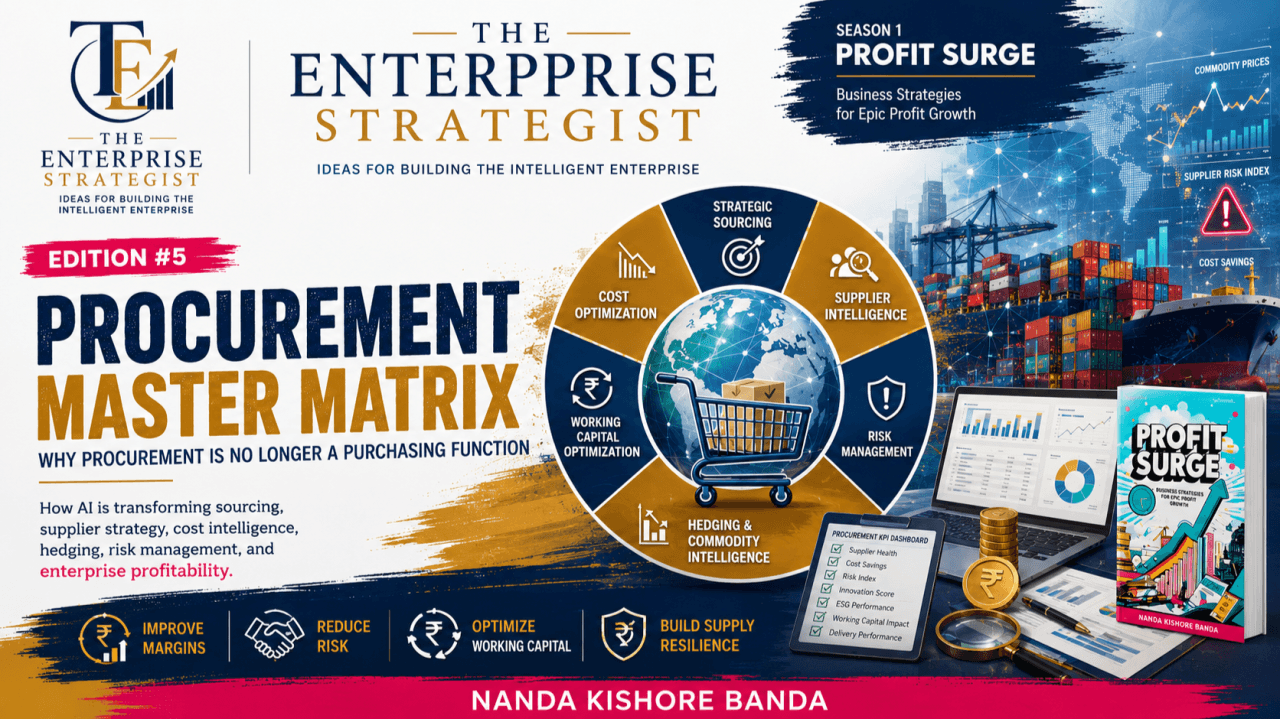
Procurement is no longer a back-office purchasing function.
It sits at the intersection of cost, resilience, supplier capability, innovation and enterprise risk—and increasingly determines whether growth translates into profit or evaporates in the supply base.
Organisations that treat procurement as transactional cost-cutting miss its strategic role. Organisations that elevate procurement without integrating it into commercial and financial decisions create another silo. The answer is a structured capability: the Procurement Master Matrix.
Beyond Purchasing: Six Strategic Pillars
The Procurement Master Matrix organises sourcing and supply management around six interconnected pillars:
- Strategic sourcing — category strategies aligned to business priorities, not annual tender cycles
- Supplier intelligence — performance, capability, financial health and innovation potential
- Risk management — concentration, geopolitical exposure, compliance and continuity planning
- Hedging and commodity intelligence — visibility into input volatility and its margin impact
- Working capital optimisation — payment terms, inventory and cash coordinated with finance
- Cost optimisation — total cost of ownership, specification discipline and demand management
Each pillar delivers value independently. Together, they form an integrated system that protects margin, reduces risk and strengthens the enterprise's ability to respond to disruption.
Modern procurement must balance cost, resilience, supplier capability and innovation—not choose among them.
How AI Is Transforming Procurement
Artificial intelligence is reshaping what procurement teams can see, model and decide.
Commodity price signals can be monitored continuously rather than quarterly. Supplier risk indices can combine financial, operational and external data. Cost savings opportunities can be prioritised by margin impact rather than by spend volume alone. Contract and specification deviations can be detected before they accumulate.
The procurement KPI dashboard of the future is not a reporting artefact. It is a decision surface—linking supplier health, cost savings, risk index, innovation score, ESG performance, working capital impact and delivery performance to the choices executives must make.
Four Enterprise Outcomes
When the Procurement Master Matrix operates effectively, four outcomes follow:
- Improve margins — through specification discipline, smarter sourcing and input volatility management
- Reduce risk — through supplier diversification, continuity planning and early warning systems
- Optimise working capital — by aligning payment terms, inventory and production with cash priorities
- Build supply resilience — so disruption does not become a recurring profit shock
These outcomes connect directly to the Profit Surge agenda: growth that survives contact with cost, cash and complexity.
From Functional Tower to Enterprise Capability
Procurement cannot deliver these outcomes in isolation. It requires explicit decision rights, shared metrics with finance and operations, and leadership recognition that supplier choices are strategic choices.
The most advanced procurement organisations do not win by negotiating harder on every contract. They win by designing categories, specifications and supplier relationships that make profitable growth easier to achieve.
Business strategies for epic profit growth—including procurement, cost intelligence and enterprise profitability.
Transform procurement from a purchasing function into a strategic profit and resilience capability.
Strategic Reflection
If your top three suppliers faced simultaneous disruption tomorrow, which product lines, margins and customer commitments would be at risk?
If procurement saved 5% on input costs but increased inventory by 10 days, would the enterprise be better off—or merely shifted the problem?
Coming Next Week
Season 1 continues with deeper explorations of route-to-market, cost transformation and the intelligent enterprise—each connecting commercial ambition to measurable profit outcomes.
Originally published as an edition of The Enterprise Strategist on LinkedIn. This page forms part of the permanent Intellectra Insights archive.