
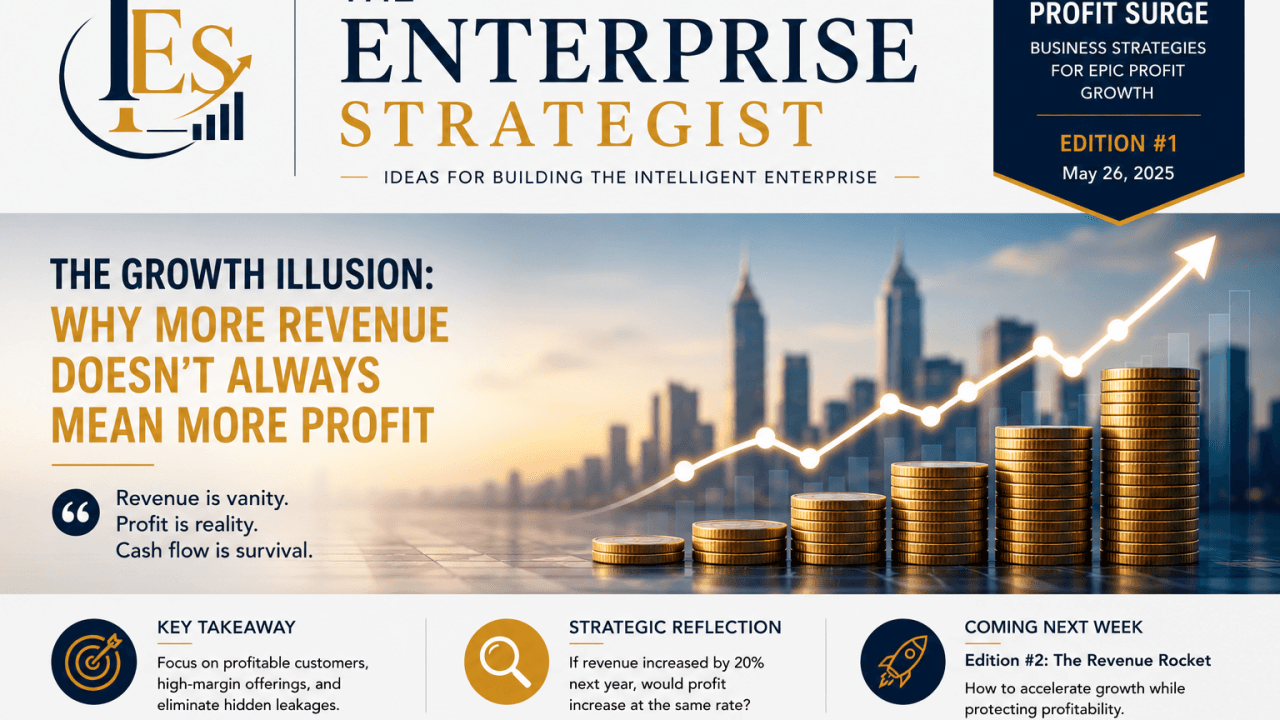
Revenue growth can create the appearance of progress while margin, mix and commercial discipline quietly deteriorate.
Boards celebrate top-line acceleration. Sales teams receive recognition for volume. Market share charts move in the right direction. Yet when the year closes, operating profit may barely move—or may even decline.
This is the growth illusion: the belief that more revenue automatically creates more value.
Revenue is vanity. Profit is reality. Cash flow is survival.
When Growth Becomes Expensive
Not all revenue is created equal. Some sales arrive with attractive margins, loyal customers and low cost to serve. Other sales are bought through discounting, excessive trade investment, unfavourable channel terms or service models that consume more resources than they return.
Leaders who manage only to revenue targets often discover—too late—that growth has been subsidised. The organisation worked harder, shipped more and invested more, yet retained less.
The problem is rarely ambition. It is insufficient distinction between growth that strengthens the business and growth that merely enlarges it.
The Hidden Leakages Behind the Top Line
Profitable growth depends on understanding where value is created and where it escapes.
- Customer profitability varies far more than most organisations admit.
- Product and pack mix can shift toward lower-margin items even when total volume rises.
- Promotional intensity may generate volume without incremental profit.
- Cost to serve differs by channel, geography and order pattern.
- Working capital can absorb cash that revenue figures never reveal.
When these dynamics remain invisible, revenue becomes a misleading scoreboard. The business appears to be winning while economics quietly weaken.
Focus on Profitable Customers and High-Margin Offerings
Sustainable growth begins with clarity about who you serve and what you sell.
Which customers generate disproportionate profit after accounting for discounts, returns, servicing and payment behaviour? Which products and packs contribute strong margin without requiring constant promotional support? Which combinations of customer, channel and pack create value—and which destroy it?
These questions are not accounting exercises. They are strategic choices. Every resource allocated to low-value demand is a resource withheld from high-value opportunity.
Leaders pursuing profitable growth must be willing to grow more selectively. That may mean saying no to volume that looks impressive but returns little.
Eliminate Hidden Leakages
Many profit problems do not require dramatic strategic reinvention. They require disciplined elimination of leakages that have become normalised.
Leakages appear in many forms: unprofitable promotions that repeat out of habit, exception pricing that never expires, channel terms that no longer reflect economics, small packs sold at large-pack economics, and service levels extended to customers who do not warrant them.
Each leakage may appear minor in isolation. Together, they can erase the benefit of substantial revenue growth.
The most effective commercial teams treat margin protection as a continuous capability—not a year-end correction.
Strategic Reflection
If revenue increased by 20% next year, would profit increase at the same rate?
If the honest answer is uncertain, the organisation may be managing growth cosmetically rather than economically.
Ask your leadership team a follow-up question: which part of that hypothetical growth would we actively choose again if we understood its full profit and cash consequences?
The hesitation that follows is often more revealing than the forecast itself.
Business strategies for epic profit growth—connecting revenue ambition to margin discipline and commercial accountability.
Coming Next Week
Edition #2: Trade Spend Tango — The Mathematics of Profitable Promotions.
We will examine how trade investment can either catalyse incremental profit or quietly subsidise sales that would have happened anyway—and how to tell the difference before the money is spent.
Originally published as an edition of The Enterprise Strategist on LinkedIn. This page forms part of the permanent Intellectra Insights archive.