
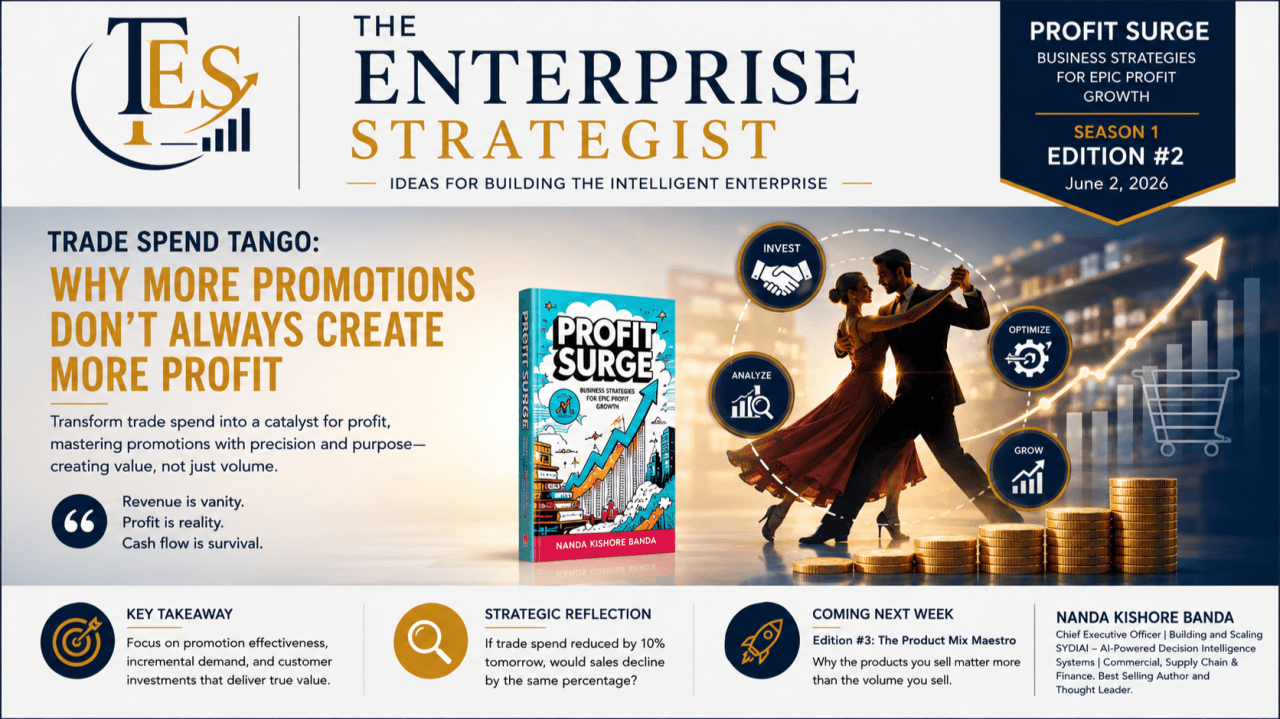
Promotions can generate impressive volume while quietly destroying value.
Trade spend is often the largest discretionary commercial investment in consumer businesses—yet it is frequently managed with more enthusiasm than mathematics.
A promotion looks successful when shelves empty, distributors reorder and revenue spikes. But revenue is not the same as incremental profit. Much of what appears to be growth may simply be timing—a pull-forward of demand that would have materialised anyway, often at a lower cost.
Transform trade spend into a catalyst for profit, mastering promotions with precision and purpose—creating value, not just volume.
The Promotion Paradox
Every promotion creates a tango between investment and return. The organisation steps forward with funding. The market responds with volume. But unless the choreography is designed with rigour, the partners move without alignment—more activity, not more value.
The central question is not whether promotions work. It is whether a specific promotion creates incremental profit after accounting for:
- Baseline sales that would have occurred without the event
- Cannibalisation of other products or packs in the portfolio
- Forward buying and post-promotion dips
- Incremental logistics, servicing and working capital costs
- Trade terms and listing investments bundled into the event
When these factors remain unmeasured, trade spend becomes a substitute for strategy—a recurring expense that buys the appearance of momentum.
Invest, Analyze, Optimize, Grow
Profitable promotion management follows a disciplined cycle rather than a calendar of habitual events.
Invest with intent. Every promotion should have a defined objective—incremental trial, competitive defence, range expansion, stock clearance—not merely a revenue target inherited from last year.
Analyze with honesty. Post-event reviews must compare performance against a credible baseline, not against the hope that volume rose. Was demand truly incremental? Did margin recover after the event? Did the right customers respond?
Optimize with precision. Reduce or redesign promotions that consistently fail to deliver incremental profit. Reinvest in events with demonstrated economics. Align pack, price and channel architecture so promotions reinforce portfolio strategy rather than undermine it.
Grow with protection. Accelerate only where promotion efficiency, customer response and margin recovery justify continued investment.
Incremental Demand—or a Sales Subsidy?
Many organisations discover, upon rigorous review, that a significant share of trade spend subsidises existing demand.
Distributors forward-buy. Retailers pass through discounts without expanding category consumption. Loyal buyers stock up while new buyers remain unaffected. The enterprise pays for volume it would likely have earned at a better margin.
This is not an argument against promotions. It is an argument against unexamined promotions. Trade spend can create genuine value when it changes behaviour—trial, switching, repertoire expansion or competitive displacement that persists beyond the event.
Strategic Reflection
If trade spend reduced by 10% tomorrow, would sales decline by the same percentage?
If leadership cannot answer confidently, the organisation may be funding habit rather than incrementality.
The goal is not to eliminate promotions. It is to ensure that every rupee of trade investment earns its place in the profit equation.
Frameworks for connecting commercial investment, promotion discipline and profitable growth.
Coming Next Week
Edition #3: The Product Mix Maestro — Why What You Sell Matters More Than How Much You Sell.
Two businesses can report identical revenue growth and produce very different profit outcomes. The difference often lies in product, pack, customer and channel mix.
Originally published as an edition of The Enterprise Strategist on LinkedIn. This page forms part of the permanent Intellectra Insights archive.