
Business leaders do not need to become programmers. But they must understand the language shaping technology investments, organisational design and competitive strategy.
Artificial intelligence has entered the boardroom vocabulary with force. Every strategy presentation references it. Every vendor claims it. Every competitor announces an initiative. Yet many leaders still nod through conversations about models, embeddings, fine-tuning, agents, guardrails and inference without confident comprehension.
That gap is no longer harmless. It creates expensive misunderstandings, weak governance and strategies built on buzzwords rather than capability.
You cannot lead what you cannot name. AI vocabulary is becoming a leadership capability—not a technical speciality.
Why Language Matters
Technology language is never neutral. It frames what leaders believe is possible, what they fund, what they fear and what they defer to others.
When a leadership team shares a precise vocabulary, conversations become shorter and decisions become sharper. When vocabulary is vague, the same meeting produces enthusiasm without direction—budget without boundaries—pilots without purpose.
The language problem is therefore a strategy problem. Leaders who cannot distinguish a foundation model from an application layer cannot evaluate vendor claims. Leaders who cannot distinguish training from inference cannot assess cost structures. Leaders who cannot distinguish an agent from an automation script cannot design accountability.
Terms Leaders Must Understand
You do not need three hundred definitions memorised before your next meeting. You do need clarity on the concepts that recur in every serious AI conversation.
- Artificial intelligence and machine learning — the distinction between broad capability and systems that learn from data.
- Foundation models and fine-tuning — general-purpose intelligence adapted to your domain.
- Training, inference and cost — where investment concentrates and where usage accumulates.
- Data quality, labelling and bias — why model performance depends on what it was taught.
- Prompts, context windows and retrieval — how models access and use information.
- Agents, tools and orchestration — when AI moves from answering to acting.
- Guardrails, governance and human oversight — how to permit capability without surrendering control.
Each term connects to a business decision: what to build, what to buy, what to permit, what to measure and what to stop.
The Dictionary as a Leadership Tool
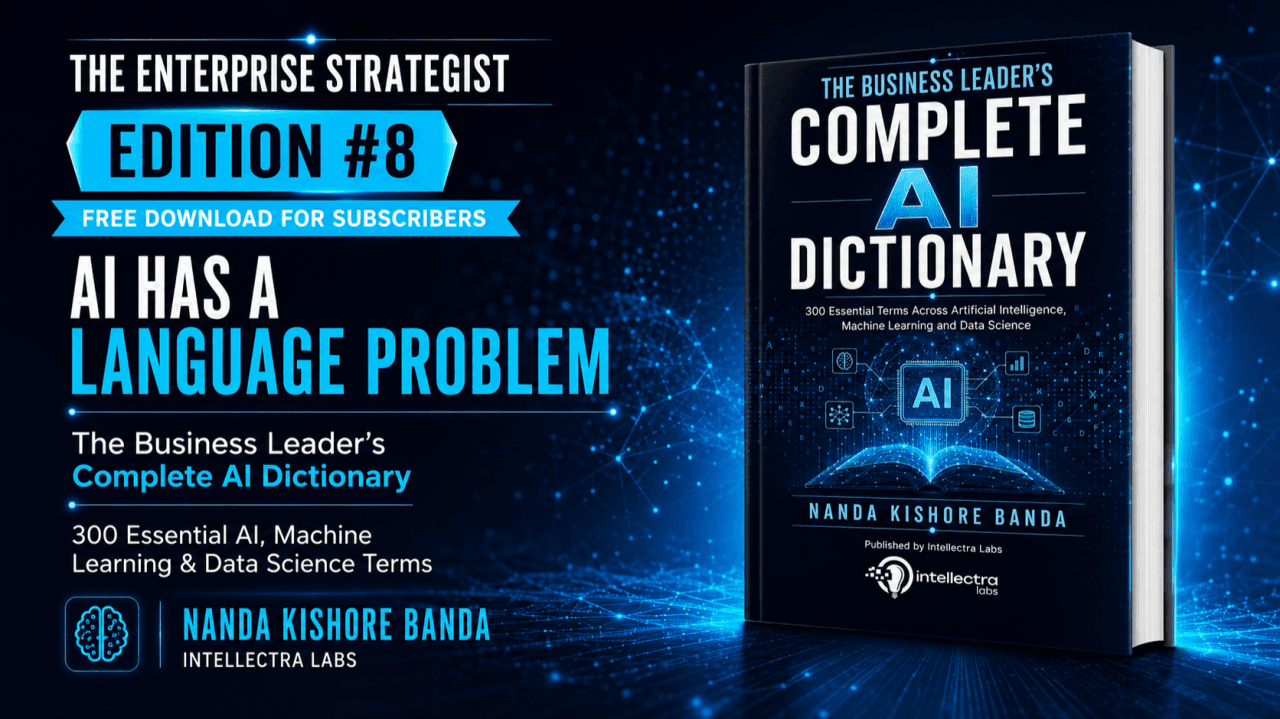
The Business Leader's AI Dictionary was created for this moment—not to turn executives into engineers, but to give them a shared reference for the conversations that now define enterprise strategy.
Three hundred essential terms across artificial intelligence, machine learning and data science—explained in language a business leader can use in the boardroom, with vendor teams and with their own technology organisations.
300 essential AI, machine learning and data science terms—explained for business leaders.
From Vocabulary to Governance
Shared language enables shared governance.
When leaders understand what an agent is, they can define what it may do. When they understand inference cost, they can set usage boundaries. When they understand bias, they can demand testing before deployment. When they understand retrieval, they can insist that answers cite authoritative data.
Without that vocabulary, governance becomes a legal document attached to a capability nobody in leadership truly comprehends.
Strategic Reflection
In your last AI strategy discussion, how many terms were used that you could not define precisely?
That count may indicate how much of your AI investment is currently guided by confidence—and how much by assumption.
Connect priorities, performance signals, scenarios and executive decisions.
Coming Next Week
Edition #9: Your Next Employee May Not Be Human—But You Must Still Design the Job.
We will examine why every AI agent entering the enterprise requires a purpose, permitted tools, decision boundaries, performance measures and an accountable human owner.
Originally published as an edition of The Enterprise Strategist on LinkedIn. This page forms part of the permanent Intellectra Insights archive.