Intellectra Labs
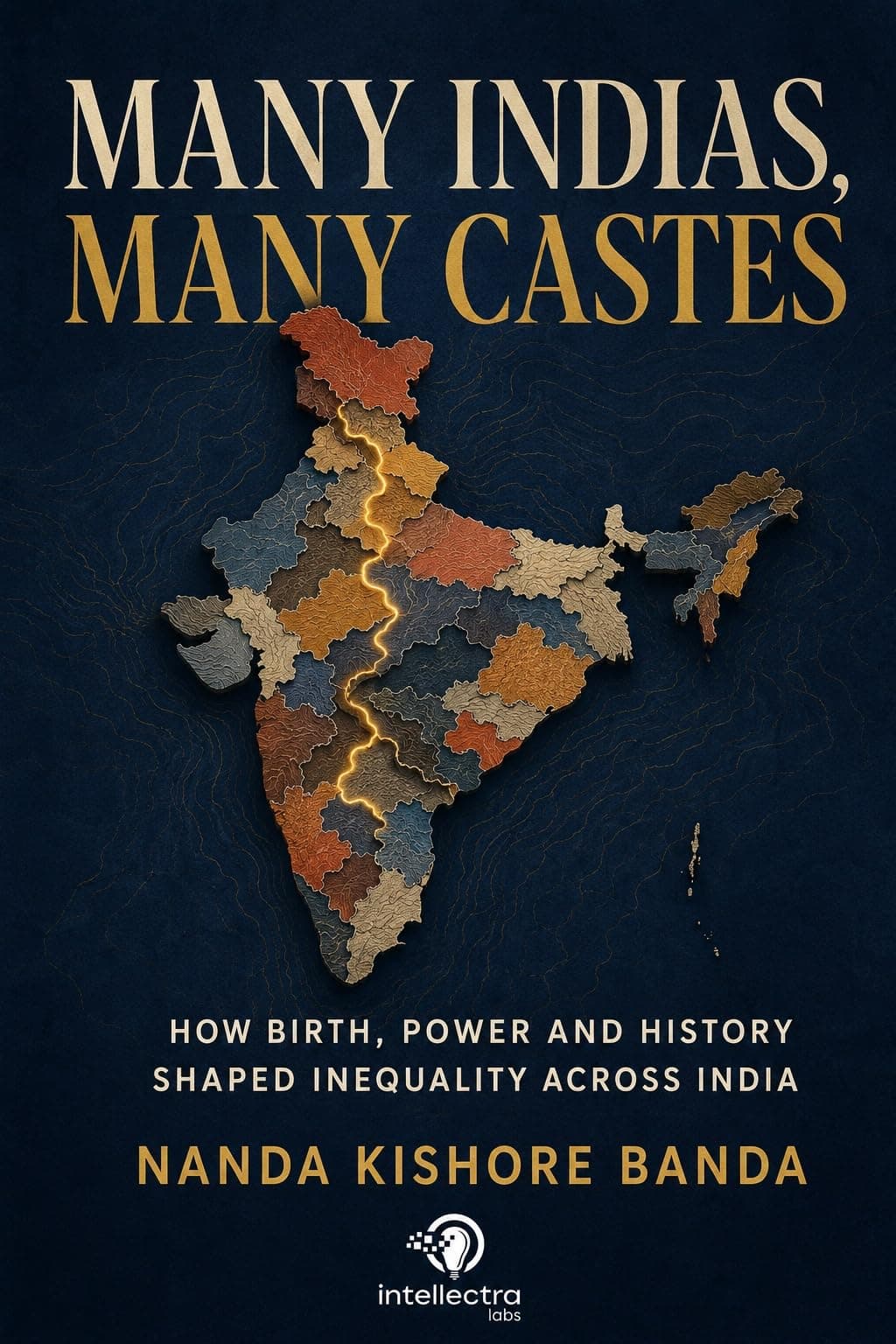
Many Indias, Many Castes by Nanda Kishore Banda — book cover
India's Unfinished DebatesPublished

Many Indias, Many Castes

How Birth, Power and History Shaped Inequality Across India

By Nanda Kishore Banda

India's Unfinished Debates, Book 2

Caste can be loud or silent, ritual or economic, violent or bureaucratic. Its language changes across Tamil Nadu, Punjab, Bengal, Maharashtra, Uttar Pradesh, the Northeast and beyond. This book replaces the idea of one unchanging national system with a regional history of power, mobility, exclusion and constitutional transformation.

Book details

Publication date
31 August 2026
Language
English
Series
India's Unfinished Debates, Book 2
Available formats
Kindle
ASIN

Kindle: B0HH8PMF77

Retailers
Amazon

Why regional comparison matters

Public debate about caste in India often fails at the first step: it assumes one uniform system where there were always many regional histories. Many Indias, Many Castes begins there—with variation as method, not footnote.

What people experienced as birth, hierarchy, labour obligation, ritual status or political identity differed across Tamil Nadu and Telangana, Uttar Pradesh and Bihar, Maharashtra and Gujarat, Bengal and the Northeast. Land, kinship, temple authority, colonial administration and indigenous orders shaped caste differently—often in ways a single national template cannot capture.

At the centre sits the distinction between varna as textual model and jati as lived organisation. Varna categories appear in scripture and argument; jati names, marriage rules and local status hierarchies govern daily life far more directly. Confusing the two produces bad history and worse policy speech.

Conversion did not automatically erase birth-based inequality. Muslim, Christian, Sikh and Buddhist communities in India carry their own histories of hierarchy, endogamy and social memory. The book examines how religious community, caste identity and constitutional equality interact without pretending one narrative fits every region.

From historical comparison, the work moves to modern institutions: reservations and regional politics, cities as spaces of mobility and segregation, corporations, marriage markets, digital life and democracy as both promise and pressure on inherited inequality.

Evidence-led throughout, Many Indias, Many Castes avoids romanticising tradition and avoids reducing India’s most painful social fact to condemnation alone. Its aim is precision—so readers can engage the caste debate with clearer categories, better questions and fewer false generalisations.

Historical Figures and Debates

Rather than one national template, the book maps how land, religion, politics and local history produced different structures of hierarchy across India.

Subjects

  • Varna and jati
  • Dalit movements
  • Dravidian movement
  • Reservation
  • Mandal politics
  • Land ownership
  • Endogamy
  • Caste and gender
  • Caste in Hinduism
  • Caste among Muslims
  • Caste among Christians
  • Caste among Sikhs
  • Religious conversion
  • Pasmanda politics
  • Urban caste
  • Corporate India
  • Electoral politics
  • Regional caste systems

Patterns the book maps

  • Regional variation in caste formation and persistence
  • Varna as textual model versus jati as lived organisation
  • Caste among Hindu, Muslim, Christian, Sikh and Buddhist communities
  • Reform, conversion, education and land redistribution
  • Constitutional equality, reservations and modern institutions
  • Endogamy, urban life and caste in democratic politics

Readers this account serves

  • Readers of Indian social, economic and political history
  • Students of sociology, caste studies and public policy
  • Readers interested in constitutional equality and reservation politics
  • Participants in contemporary social debates seeking evidence over slogan
  • Educators needing a regional rather than monolithic account of caste

What comparative reading unlocks

  • Understand why caste developed differently across Indian regions and communities
  • Distinguish varna as ideal type from jati as everyday social organisation
  • Examine caste dynamics across major religious communities without oversimplification
  • Trace how reform, conversion and policy reshaped—but rarely erased—hierarchy
  • Explore how caste persists through marriage, housing, networks and political life
  • Engage India's caste debate with regional and historical precision

About the author

Nanda Kishore Banda Author, enterprise strategist and founder of Intellectra Labs—writing on business, AI, Vedanta, Indian philosophy, history, society and cinema with clarity without simplification.

Related books

Continue reading within India's Unfinished Debates or explore connected titles across the libraries.

The Manusmriti on Trial by Nanda Kishore Banda — book cover
Available NowIndia's Unfinished Debates, Book 1

The Manusmriti on Trial

Caste, Gender, Dharma—and the Battle Over India's Most Controversial Text

Few Indian texts are condemned, defended and quoted as fiercely as the Manusmriti. This evidence-led examination separates text from mythology, history from polemic and inherited law from the modern constitutional order.

Two Nations of the Mind by Nanda Kishore Banda — book cover
Available NowThe Arguments That Made India

Two Nations of the Mind

Savarkar and Gandhi — Strength, Conscience, and the Meaning of India

Savarkar and Gandhi imagined strength, freedom and India through radically different moral worlds. This balanced intellectual confrontation examines two compelling visions without reducing either thinker to a slogan, saint or villain.

Reel Revolutions by Nanda Kishore Banda — book cover on Indian film directors and cinematic craft
Available NowThe Indian Screen Rewritten

Reel Revolutions

Eleven Directors Who Rewired Indian Cinema

Indian cinema did not evolve gently—it was repeatedly rewired by filmmakers willing to break its visual, emotional and commercial rules. Reel Revolutions examines eleven directors who changed what Indian films could see, say and become.

Continue with this book

Purchase on Amazon or explore more titles across the five libraries.