
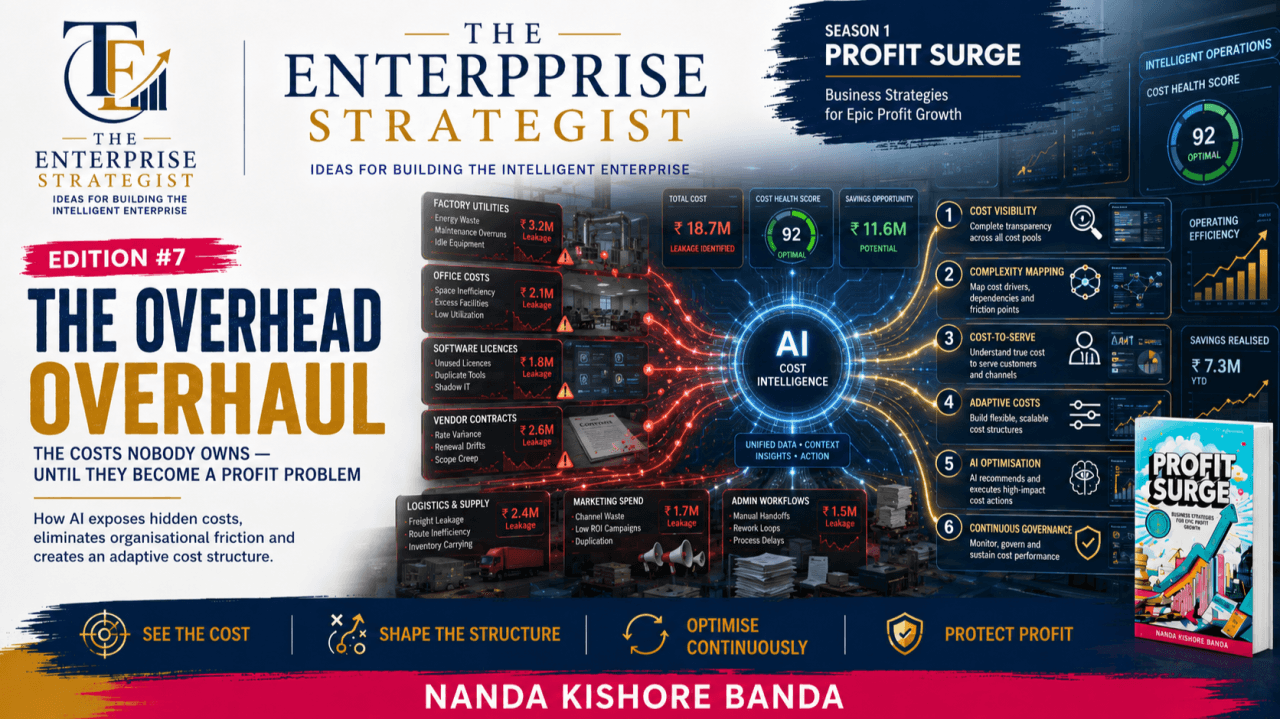
Overheads rarely grow because of one dramatic decision. They accumulate through fragmented ownership, inherited processes and individually reasonable choices that become collectively expensive.
Factory utilities drift upward. Office space remains under-utilised. Software licences multiply. Vendor contracts renew on autopilot. Logistics routes lose efficiency. Marketing spend duplicates across teams. Administrative workflows absorb hours in manual handoffs and rework.
Each item has an explanation. Each decision was defensible in isolation. Yet together they can erode margin long before leadership recognises a cost crisis.
Overheads become a profit problem when nobody owns them—and everybody assumes someone else will.
The Ownership Gap
Direct costs usually have clear owners. Raw materials belong to procurement. Production labour sits with operations. Freight may sit with logistics.
Overheads are different. They sit between functions. Energy spans operations and finance. Software licences span IT and every business user. Vendor contracts span procurement, legal and the requesting function. Process waste spans everyone who touches the workflow.
When ownership is fragmented, accountability dissolves. Costs grow not because leaders approve large investments, but because small leaks continue without a named owner responsible for closing them.
Where Leakage Hides
Cost transformation begins with visibility—not with a blunt percentage reduction target.
- Factory utilities — energy waste, maintenance overruns and idle equipment.
- Office and facilities — space inefficiency, excess facilities and low utilisation.
- Software licences — unused seats, duplicate tools and shadow IT.
- Vendor contracts — rate variance, renewal drift and scope creep.
- Logistics and supply — freight leakage, route inefficiency and inventory carrying cost.
- Marketing spend — channel waste, low-ROI campaigns and duplicated activity.
- Administrative workflows — manual handoffs, rework loops and process delays.
These categories look familiar because they appear in nearly every enterprise. What differs is whether the organisation can see them clearly, assign ownership and act before they compound.
A Six-Step Framework for Adaptive Cost Structure
Sustainable overhead reduction is not a one-time exercise. It is a capability built through six connected disciplines.
- Cost visibility — complete transparency across cost pools, not only headline categories.
- Complexity mapping — understand cost drivers, dependencies and friction points.
- Cost-to-serve — measure the true economics of customers, channels and service models.
- Adaptive costs — design structures that flex with volume and demand rather than locking in fixed waste.
- AI optimisation — use intelligence to recommend and execute high-impact actions with human oversight.
- Continuous governance — monitor, govern and sustain performance rather than declaring victory after one programme.
Organisations that skip visibility and move straight to cuts often damage capability. Organisations that build visibility without governance often rediscover the same leaks two years later.
Complexity as a Cost Driver
Much overhead growth is complexity growth in disguise.
Every additional approval layer, exception process, duplicate system, non-standard report and inherited workaround adds cost without adding customer value. Complexity feels safe because it preserves optionality. Over time, it becomes a tax on every decision.
Cost transformation therefore requires the courage to simplify—not merely to negotiate harder.
AI and Cost Intelligence
Artificial intelligence does not replace financial discipline. It makes hidden patterns visible sooner.
Unified data and context can reveal where energy consumption diverges from production patterns, where licence utilisation falls below contracted levels, where vendor rates drift from benchmarks, and where process delays create recurring rework.
The value lies not in the insight alone—but in connecting insight to action with clear ownership and measurable savings.
Strategic Reflection
Which overhead category in your organisation has grown for three consecutive years without a named owner accountable for its trajectory?
That category may already be a profit problem waiting for a label.
Business strategies for epic profit growth—including cost transformation and margin protection.
Coming Next Week
Edition #8: AI Has a Language Problem—and Business Leaders Cannot Afford to Ignore It.
We will examine why business leaders must understand the vocabulary shaping technology investments, organisational design and competitive strategy.
Originally published as an edition of The Enterprise Strategist on LinkedIn. This page forms part of the permanent Intellectra Insights archive.