
Distribution numbers cannot reveal whether the right products are reaching the right outlets through an economically sensible service model.
Many organisations measure route-to-market success through coverage: outlets visited, distributors appointed, beats planned, shelves filled. These metrics matter—but they describe activity, not advantage.
Intelligent route-to-market begins with the commercial DNA of each market. It asks where demand is concentrated, which channels create value, what service model the economics can support, and how execution should adapt as conditions change.
Coverage tells you where you are present. Intelligent route-to-market tells you where you should be—and how to win profitably when you arrive.
Beyond Distribution Counts
A business can appear widely distributed while remaining commercially blind.
Products may reach outlets with low potential while high-potential micro-markets remain under-served. Channels may be chosen by habit rather than economics. Territory plans may optimise visit frequency without connecting effort to opportunity. Distributor networks may grow in size while weakening in responsiveness.
The result is expensive reach: more people, more vehicles, more inventory in motion—without a corresponding increase in profitable availability.
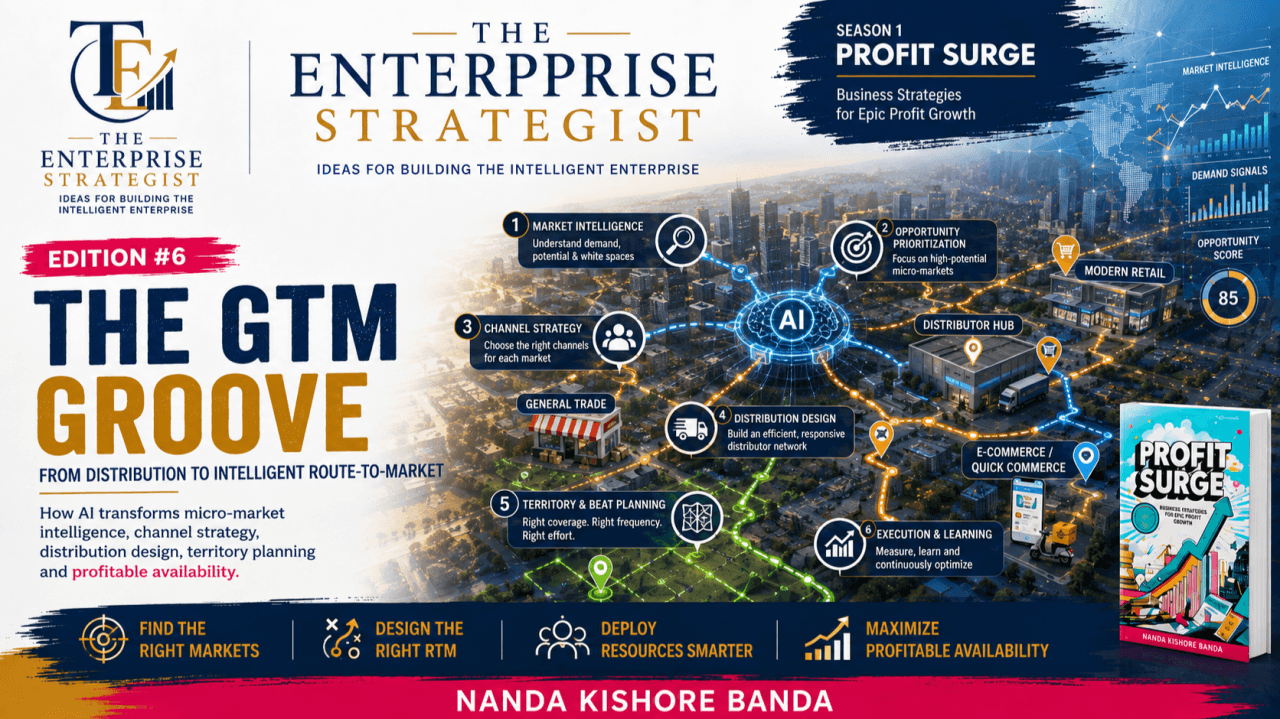
A Six-Step Framework for Intelligent Route-to-Market
Moving from distribution to intelligent route-to-market requires a connected sequence of decisions—not a single reorganisation project.
- Market intelligence — understand demand, potential and white spaces at micro-market level.
- Opportunity prioritisation — focus resources on high-potential outlets, geographies and occasions.
- Channel strategy — choose the right channels for each market rather than applying one model everywhere.
- Distribution design — build an efficient, responsive distributor and service network.
- Territory and beat planning — align coverage, frequency and effort with commercial opportunity.
- Execution and learning — measure performance, detect leakage and continuously optimise.
Each step depends on the one before it. Territory planning without market intelligence produces busy field teams. Channel strategy without cost-to-serve analysis produces attractive reach with weak economics.
Market Intelligence and Micro-Markets
Markets are not uniform. Within a single city, demand intensity, competitive presence, outlet potential and channel structure can vary dramatically from one micro-market to the next.
Intelligent route-to-market begins by understanding that variation. Which outlets generate disproportionate category value? Where is white space genuine—and where is it merely empty shelves with weak economics? Which demand signals predict opportunity before it appears in monthly sales reports?
AI and modern analytics make this intelligence more accessible—but only when organisations treat it as a commercial input, not a reporting curiosity.
Channel Strategy and Economics
General trade, modern retail, e-commerce and quick commerce each play different roles. The question is not which channel is fashionable. It is which channel fits the category, the occasion, the pack architecture and the cost to serve in a given market.
A channel that expands reach while destroying margin is not a growth lever. It is a subsidy. Intelligent route-to-market connects channel choice to portfolio design, service requirements and distributor economics before scaling activity.
Execution That Learns
The final test of route-to-market design is not the plan—it is what happens at the outlet.
Are the right products available where demand exists? Is visit frequency aligned with opportunity? Are out-of-stock events detected early enough to act? Does the organisation learn which interventions create incremental profit and which merely move volume between periods?
Execution without learning repeats yesterday's mistakes at greater scale. Learning without execution remains a dashboard exercise.
Strategic Reflection
If you removed 20% of your lowest-value coverage tomorrow, would profit rise, fall or remain unchanged?
If the answer is uncertain, the organisation may be managing distribution rather than designing route-to-market.
Connect market opportunity, channel economics, portfolio choices and execution to profitable growth.
Business strategies for epic profit growth—including intelligent route-to-market design.
Coming Next Week
Edition #7: The Overhead Overhaul — The Costs Nobody Owns—Until They Become a Profit Problem.
We will examine how overheads accumulate through fragmented ownership, inherited processes and individually reasonable choices that become collectively expensive.
Originally published as an edition of The Enterprise Strategist on LinkedIn. This page forms part of the permanent Intellectra Insights archive.